The Project: TIM’s Game Prototype Usability Test for Social Media
Client: TIM Brasil

TIM Brasil (officially TIM Celular S.A.) is the Brazilian subsidiary of Telecom Italia, an Italian telecommunications company, which owned 67% of the company as of 2014. [3] TIM Celular started its activities in Brazil in 1998 and since 2002 has consolidated its national presence, becoming the first mobile phone company present in all Brazilian States and, as of April 2017, has over 61.3 million customers.
The Company, through the GSM technology, has a national reach of approximately 93% of urban population and offers services to mobile and fixed telephony, data transmission and Internet access at high speed, bringing the convergence of services for all its customers in a single company .
TIM Celular is headquartered in Rio de Janeiro and is listed in BM & F Bovespa and NYSE, in São Paulo and New York City, respectively. Oficial website
UX Team:
- Joana Andrade – UX Leader / Fhios Brazil – UX Consultancy Agency
- Antônio Mozelli – UX Designer / Fhios Brazil – UX Consultancy Agency
- Camila Mantovani – User Researcher
The Usability study objective:
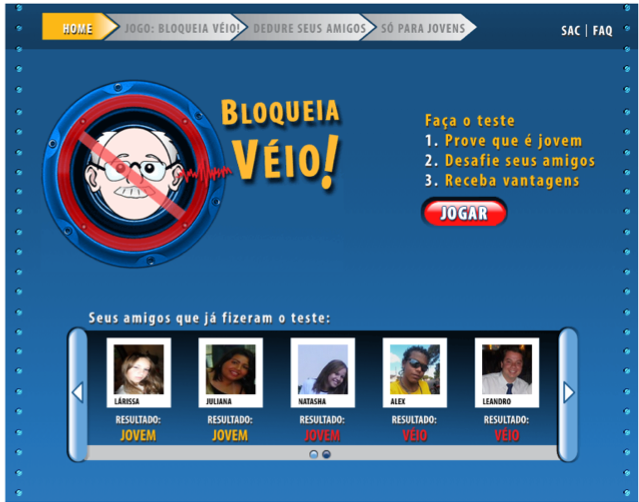
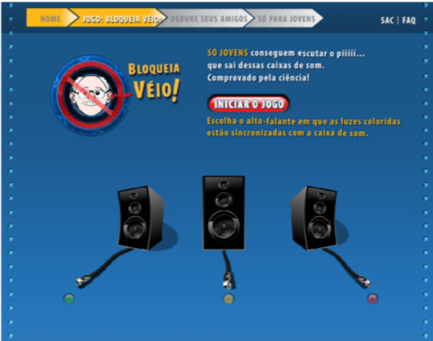
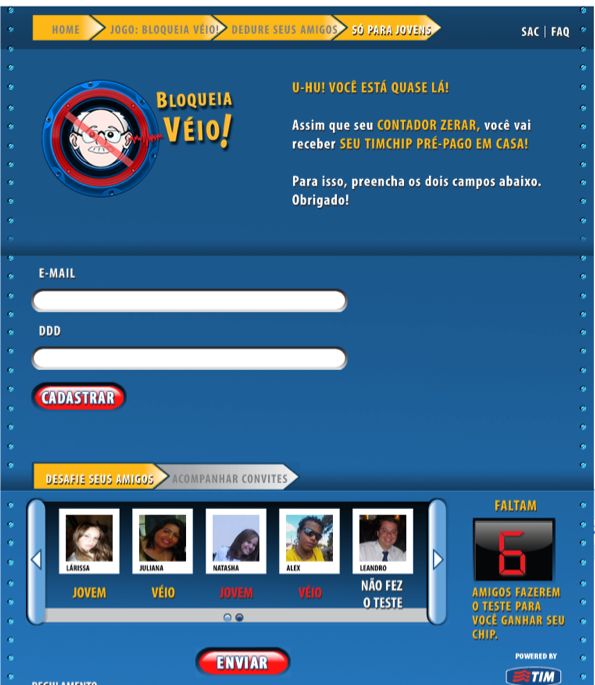
The study investigates the navigational structure and the experience of using the new application/game called ‘Bloqueia Véio” through the perception of the users. The expectations of these users regarding the presented concepts, as well as the needs of the available tools and contents.
The study aimed to explore the objectives listed below in the prototype of the ‘Bloqueia Véio’ application:
- Evaluate the attractiveness of the communication of a new offer of the company in the midst of unconventional media.
- Test how much the motto ‘Bloqueia Véio’ has the strength to generate attention, interest and desire to take the young person to carry out the test.
- Validate the effectiveness of the “young chip” offer and the acceptance of the benefits.
- Evaluate the new campaign with end users focusing on:
- Adherence to users’ needs
- Ability to communicate with the public
- Validate the application’s viral capacity (BUZZ potential).
- Ease of Use
Specific objectives:
- Communication test for launch:
- Likes and dislikes
- Level of impact and persuasion
- Emotional / rational appeal
- Link to the brand
- Level of Engagement / Engagement
- Evaluation of the concept:
- Degree of understanding and attractiveness
- Advantages and disadvantages
- Attributes more valued in the offer
- Intention of participation / adhesion
- Determining factors for participation / adherence
- Barriers to participation / membership, Reasons
- Main appeal of the new offer for communication.
The following research methodologies were used in this study:
- Cognitive Walkthrough
- Observation of participants;
- Verbal Protocol ‘Thinking aloud’ (participants are invited to verbalize their thoughts while interacting with the tools);
- Tasks performed during the study;
- Report of interviews with participants.
- Completion of questionnaires (expressions of preference)
- Participants were invited to complete the tasks and then evaluate the interfaces of the sites based on their experiences during the tests.
My duties on the project:
As a UX Designer, I performed the following tasks:
- Assistance in all user research processes
- Assistance in assembling and managing the usability lab facility
- Development of user questionnaires
- Observation of user tasks performed during the usability test
- Development of the final usability study report
Study results:
The results for this usability study are confidential and it is Tim Brasil’s property.
 a/m
a/m 